Leak Detection in Hamilton Heights, Manhattan
Unexplained ceiling discoloration, bubbling paint, or damp floorboards in historic Hamilton Heights brownstones, pre-war apartment buildings, co-ops, and condominiums require methodical, non-destructive investigation. When water migrates through masonry cavities, structural floor joists, or communal utility chases, we trace the source accurately without unnecessary wall demolition.
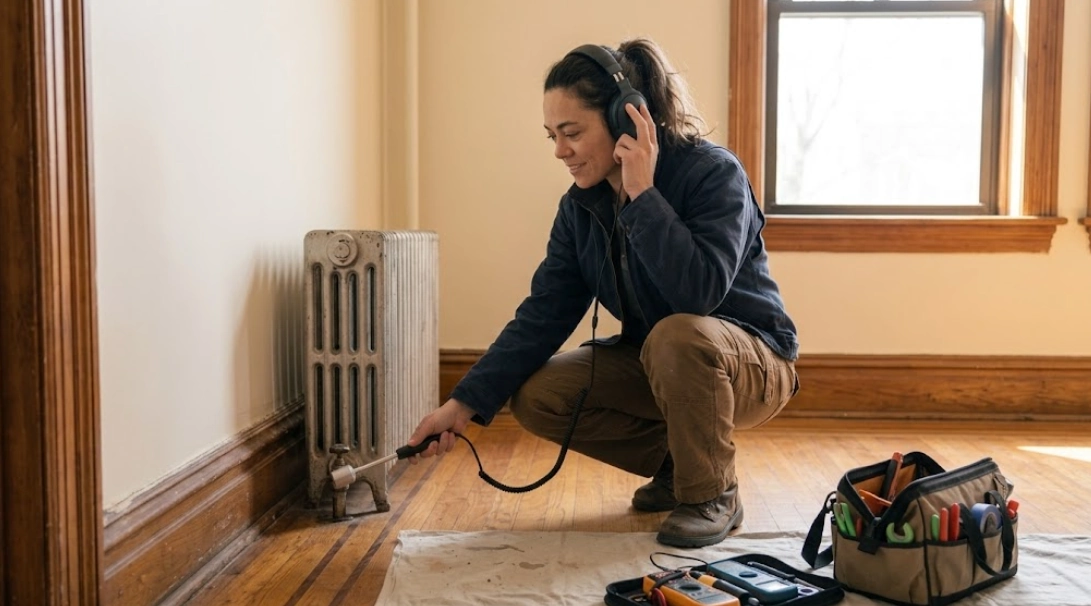
Recognizing the Warning Signs of a Hidden Water Leak
Concealed plumbing leaks rarely announce their true point of origin immediately. Instead, escaping water travels quietly along subfloors, ceiling plaster, and partition framing until visible symptoms appear. Identifying these subtle warnings early helps homeowners, property managers, and co-op shareholders address moisture before extensive structural decay or mould growth takes hold.
Damp or Discolored Ceilings
Expanding yellow, tan, or dark brown rings on plaster or drywall indicate moisture seeping downward from an upstairs fixture, waste arm, or vertical chase.
Peeling Paint & Bubbling Plaster
Water trapped within wall cavities causes paint to blister and plaster to soften or crumble, signaling an active pipe leak behind the wall.
Persistent Musty Odors
An ongoing, damp smell that lingers in bathrooms, hallways, or closets points to trapped humidity and hidden mildew inside enclosed wall shafts.
Moisture Near Pipes & Fixtures
Damp baseboards, condensation beneath sinks, or wet flooring around toilets suggest compromised supply lines or failing wax ring seals.
Unexplained Water Bill Increases
A sudden or gradual increase in municipal water charges without a corresponding change in household use suggests continuous water loss from a concealed line.
Stains Worsening After Plumbing Use
Staining that expands specifically after an upstairs neighbor drains a bathtub or runs a washing machine points to a drainage or fixture trap issue.
It is important to remember that visible stains alone do not prove where a leak originated. Water often follows horizontal steel beams or electric conduits for many feet before dripping through a ceiling, making professional diagnostic tracing essential.
Why Leak Detection Matters in Hamilton Heights
Hamilton Heights is celebrated for its historic architectural character, encompassing stately rowhouses, Romanesque Revival brownstones, and expansive pre-war apartment buildings constructed during the early twentieth century. From the elevated avenues of Sugar Hill near Convent Avenue and St. Nicholas Avenue to residential corridors near City College of New York, Hamilton Grange, and Riverbank State Park, the neighborhood features intricate plumbing infrastructures operating within dense, multi-unit layouts.
In these classic properties, plumbing networks frequently combine original or vintage galvanized iron supply risers, heavy cast-iron wastewater stacks, and steam heating lines embedded within thick masonry fireproofing. When a joint fatigues or a pipe wall corrodes, water travels through communal chase spaces and subfloor voids across multiple apartments before emerging.
Attempting to find leaks by tearing open plaster or breaking historic tiles without prior diagnostic mapping often leads to widespread cosmetic destruction without locating the true fault. Methodical hidden water leak detection Hamilton Heights Manhattan technicians provide precise localization, minimizing property disruption and expediting repairs.
Suspect a Concealed Leak in Your Building?
Whether you are managing a historic multi-family property or noticing moisture in your apartment, speak directly with our local diagnostic team to discuss your observations.
Call (315) 202-8009Common Plumbing Leak Challenges We Investigate
In multi-story residential buildings, water leaks fall into several distinct mechanical categories:
Water Leaks Between Adjoining Apartments
Investigating a water leak from upstairs apartment Hamilton Heights Manhattan requires careful coordination between neighbors, building supers, and managing agents. Testing confirms whether moisture stems from an individual tenant fixture (such as a shower drain or valve) or a communal building riser.
Ceiling Moisture and Overhead Staining
Ceiling damage is among the most frequent calls in pre-war properties. Diagnostic evaluations for ceiling leak repair Hamilton Heights Manhattan verify whether moisture is active, intermittent, or residual before any plaster restoration is scheduled.
Concealed Wall Cavity Pipe Leaks
Pressurized hot and cold supply lines concealed inside partition walls can develop pinhole perforations. Through specialized leak in wall detection Hamilton Heights Manhattan, acoustic sound sensors amplify the high-frequency vibrations of escaping pressurized water within enclosed cavities.
Shared Risers and Deteriorating Stacks
Multi-family properties depend on vertical utility chases. When aged galvanized risers experience systemic internal rust, building owners frequently evaluate planned repiping services to replace antiquated pipes with code-compliant copper lines.
Mechanical Equipment Leaks
Water heaters, boilers, and closed hydronic heating lines can develop relief valve leaks, circulator seal weeping, or internal tank failures. For dedicated heating inspections, our team provides diagnostic support for boiler repair and water heater repair.
How a Professional Leak Detection Visit Works
A methodical diagnostic approach ensures that plumbing issues are identified accurately without premature wall removal. Here is how a standard diagnostic evaluation proceeds:
- Symptom Review & Timing: We discuss when moisture first appeared and whether it is continuous (suggesting a pressurized supply line) or intermittent (suggesting a drainage or fixture use issue).
- Visual & Fixture Inspection: Accessible faucets, shut-off valves, fixture traps, toilet bases, and mechanical valves in the affected area and neighboring rooms are inspected for weeping or condensation.
- Thermal Infrared Imaging: High-resolution thermography cameras scan plaster, drywall, and tiled surfaces for temperature variations caused by evaporating or pooling water behind walls.
- Acoustic Vibration Tracing: Sensitive acoustic listening sensors isolate the sound of water escaping under pressure within concealed pipes.
- Moisture Mapping: Calibrated moisture meters verify the physical boundaries of dampness in structural building materials.
- Findings & Repair Plan: We explain our technical findings, pinpoint the likely origin point, and recommend appropriate next steps for a lasting mechanical repair.
While non-destructive tools drastically reduce unnecessary wall demolition, selective access openings may sometimes be necessary once the source is isolated so that a plumber can execute the required pipe repair.
When to Act: Water Safety and Urgency
Certain water leak situations require immediate attention to protect building occupants and prevent structural failure:
- Active Water Inundation: When water is actively pouring through ceilings or flooding floors, shut off the nearest accessible water valve immediately.
- Moisture Near Electrical Fixtures: If water is dripping through ceiling light fixtures, near wall switches, or near electrical service panels, do not touch wet switches. Keep clear of standing water and switch off the circuit breaker from a dry, safe location. Contact emergency services if active hazards exist.
- Expanding Heavy Ceiling Bulges: A sagging plaster ceiling holds trapped water and risks collapsing under its own weight. Keep clear of the area below and place containers to catch drips.
- Notify Building Staff: In co-ops and managed apartment buildings, alert the resident superintendent immediately so communal shutoffs can be managed if needed.
Suspected Gas Odor Safety Warning
If your plumbing concerns involve gas lines or you smell a natural gas odor (like rotten eggs), evacuate the premises immediately. Do not use electrical switches or phones inside. Once safely outside at a distance, call 911 or Con Edison (1-800-75-CONED). Do not use this website for active gas emergencies.
Supporting Plumbing Diagnostic & Repair Services
Beyond precision leak detection, we provide comprehensive technical support for Hamilton Heights residential plumbing systems.
Pipe Leak Repair
Targeted mechanical repairs for pinhole copper leaks, corroded lines, cracked fittings, and burst pipes inside walls and ceilings.
Learn About Pipe Leak Repair →Repiping
Systemic replacement of old, corroded galvanized supply lines with modern, code-compliant copper risers and branch piping.
Learn About Repiping →Water Heater Repair
Diagnosing inconsistent hot water, pilot issues, faulty heating elements, and tank weeping for gas, electric, and boiler-fed units.
Learn About Water Heater Repair →Boiler Repair
Troubleshooting steam radiators, hydronic circulating pumps, pressure relief valves, and no-heat calls in residential buildings.
Learn About Boiler Repair →Gas Line Repair & Inspection
Gas line testing, appliance connections, piping repair planning, and NYC Local Law 152 periodic inspection guidance.
Learn About Gas Line Services →Drain Cleaning
Clearing stubborn kitchen sink clogs, bathroom blockages, scale accumulation in cast-iron stacks, and main sewer line stoppages.
Learn About Drain Cleaning →Backflow Testing
Annual backflow assembly inspection, NYC DEP test report filing, repair rebuilds, and cross-connection containment protection.
Learn About Backflow Testing →Proactive Leak Prevention and System Care
Preventing hidden water damage requires ongoing vigilance and sensible plumbing habits:
- Conduct Periodic Visual Checks: Regularly inspect under-sink cabinets, radiator valves, and water heater supply connections for minor weeping, mineral crusting, or green oxidation.
- Know Your Shut-Off Valves: Ensure every adult in your household knows the location of individual fixture stop valves and the main apartment water shutoff, testing them periodically to ensure they turn freely.
- Report Moisture Promptly: In shared buildings, report minor moisture stains to building management immediately before small leaks escalate into major multi-floor insurance claims.
- Document Symptoms: Take photos of damp areas with dates to help technicians track whether water migration is spreading or localized.
Local Service Coverage Across Upper Manhattan
Our team focuses primarily on precision apartment leak detection Hamilton Heights Manhattan, with dedicated coverage extending across Sugar Hill and neighboring Upper Manhattan communities. We regularly assist property owners seeking leak detection near Sugar Hill, as well as nearby properties in Harlem and Washington Heights.
Whether your property is an elevator co-op on Convent Avenue, a historic brownstone on Hamilton Terrace, or a multi-family building near Broadway, our diagnostic equipment is tailored to the specific plumbing architectures of Upper Manhattan.
Frequently Asked Questions
Common questions regarding water leak detection in Hamilton Heights apartments and residential buildings.
How can a hidden water leak be located behind an apartment wall without unnecessary demolition?
Technicians use non-invasive diagnostic tools, including high-resolution infrared thermal imaging to trace temperature changes created by escaping water, sensitive acoustic listening sensors to capture the vibrations of pressurized water leaks, and calibrated moisture meters to map moisture boundaries before any selective access opening is considered.
Can a ceiling leak in my apartment originate from another unit upstairs?
Yes. In multi-family Hamilton Heights buildings, water routinely travels across concrete subfloors, structural steel beams, or down shared plumbing chases before surfacing through a ceiling. Diagnostic testing helps confirm whether the water originates from an upstairs shower pan, a localized branch line, or a communal building riser.
Does leak detection always prevent opening walls?
Non-invasive leak detection isolates the specific failure coordinates so that exploratory damage across multiple rooms is avoided. While a neat, localized opening may be required once the precise leak point is identified so that a mechanical pipe repair can be completed, widespread destructive demolition is prevented.
What should I do immediately if I observe water dripping from my ceiling?
Place buckets or plastic containers beneath the drip to catch standing water, protect flooring with towels, and avoid any wet lighting fixtures or electrical outlets. Promptly notify your building superintendent and upstairs neighbor, and contact a plumbing diagnostic specialist to trace the water source.
When is a professional leak inspection warranted?
Arrange an inspection as soon as you notice unexplained ceiling rings, bubbling plaster, warped floorboards, persistent musty smells, or the sound of rushing water inside walls when no fixtures are operating. Early detection prevents structural rot and costly damage between adjoining apartments.
Speak Directly With a Plumbing Diagnostic Specialist
Have questions about an unexplained water stain, damp drywall, or suspicious moisture in your Hamilton Heights building? Call us directly to discuss what you are observing and schedule a diagnostic visit.
When you call, let us know the affected rooms, when the moisture first appeared, whether the drip is constant, and if your building has an accessible shutoff valve. We provide clear, practical diagnostic guidance.